


What is a three high rolling mill process
You use the three high rolling mill process to reduce material thickness and improve surface quality. This process features three rolls stacked vertically, each rotating in opposite directions. The unique roll arrangement allows you to pass materials through two gaps without reversing them, which increases efficiency. You see this technology in action across many industries. The global market for rolling mill and metalworking machinery is set to grow from $30.9 billion in 2026 to $40.18 billion by 2030. This growth shows how important advanced systems like the three roll mill have become for modern manufacturing.
Key Takeaways
The three high rolling mill process enhances efficiency by allowing continuous material flow without reversing rolls, saving time and energy.
This mill design improves product quality by achieving precise thickness and stable metallurgical properties, essential for industries like electronics and cosmetics.
Advanced features like Automatic Gauge Control and cooling systems ensure high precision and consistent results, reducing downtime and maintenance needs.
Choosing a three high rolling mill is ideal for high-output production, especially when processing materials that require tight tolerances and uniformity.
Three high rolling mill design
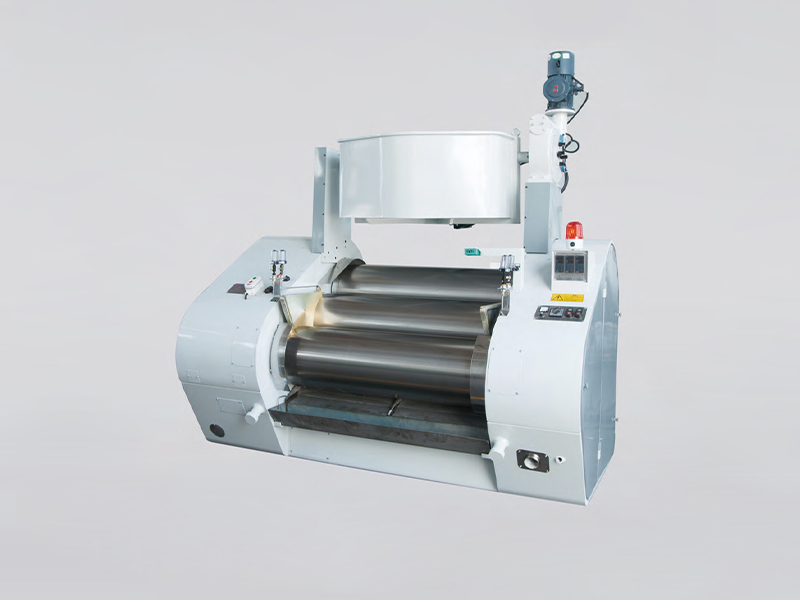
Roll arrangement and direction
You see a three high rolling mill with three rolls stacked one above the other. The top and bottom rolls turn in the same direction. The middle roll turns in the opposite direction. This setup creates two working gaps for the material. You can check the main features below:
The three rolls sit vertically, one on top of the next.
The top and bottom rolls rotate together in one direction.
The middle roll rotates in the opposite direction.
This arrangement forms two rolling gaps for processing.
This design lets you use both gaps without stopping or reversing the rolls. You get a steady and efficient process.
Material flow process
You feed the workpiece between the bottom and middle rolls first. The rolls grip the material and reduce its thickness. After the first pass, you guide the material back between the middle and top rolls. The direction of rotation means you do not need to reverse the rolls or the motor. This saves time and energy.
Here is a simple comparison of how this process improves efficiency:
Mill Type | Configuration Details | Operational Efficiency |
|---|---|---|
Two-high Mill | Uses two rollers; requires reversing or manual handling between passes. | Higher idle time due to reversing the motor or manual handling. |
Three-high Mill | Features three vertically stacked rollers; allows continuous material flow. | Significantly improved throughput with no idle time, as the motor runs continuously. |
You can see that the three roll mill design allows for continuous material flow. You do not need to stop the machine or move the material by hand. This makes your operation faster and more productive.
Key components
You need several important parts for a three roll mill to work well:
High-quality rolls: Choose rolls made from hardened steel or ceramic. These materials last longer and resist wear.
Speed control: Adjust the speed to get the best results. Higher speeds can make the process faster, but too much speed can cause overheating and wear.
Temperature management: Use cooling systems to control heat. Friction from rolling can raise the temperature and change the properties of your material.
Operator training: Learn how to set roll gaps, control speed, and monitor temperature. Good training helps you get the best performance and keeps the process safe.
You find these features in advanced three roll mill models. For example, some mills use dual-metal alloy or ceramic rollers for extra durability. Others include dynamic cooling systems to protect sensitive materials. When you use a three roll mill with these components, you get precise and reliable results.
Three roll mill working principle
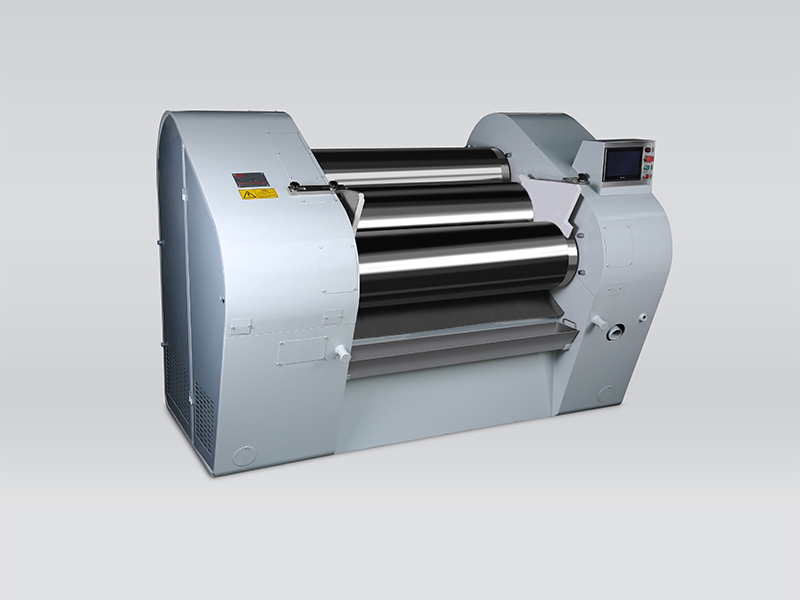
Shear force and dispersion
You use a three roll mill to mix and disperse materials by applying strong shear force. The three rollers rotate at different speeds. When you feed material into the first gap, the rollers compress and stretch it. As the material moves to the second gap, the rollers create even more shear. This two-stage process breaks down clumps and spreads particles evenly. You get a smooth, uniform mixture, which is important for products like inks, cosmetics, and electronic pastes.
Tip: The high shear rates in a three roll mill make it perfect for handling thick, sticky materials that are hard to mix with other machines.
The effectiveness of this process depends on several factors. The number of passes through the mill, the viscosity of your material, and the amount of shear force all play a role. You can see how these factors affect results in the table below:
Parameter | Value |
|---|---|
Highest electrical conductivity | 128 S/cm |
Number of passes for optimal result | 20 |
Effect of viscosity on conductivity | Decreases with increase in viscosity, increases with number of passes |
Relationship of shear force and conductivity | Initially increases, then decreases with increased shear energy |
You can adjust the number of passes and the speed of the rollers to get the best results for your material.
Hydraulic and cooling systems
You find advanced hydraulic systems in modern three roll mills. These systems help you control the pressure between the rollers with great accuracy. Automatic Gauge Control (AGC) lets you set the gap between rollers as small as 3–5 microns. This level of control improves the quality of your final product. Looper hydraulics make it easier to handle the material as it moves through the mill. Coiler systems and auxiliary hydraulics support the main process and help with maintenance.
Feature | Description | Impact on Performance |
|---|---|---|
Automatic Gauge Control (AGC) | Highest precision with 3–5 µm spool clearance, operates at 200–315 bar. | Ensures precise control, enhancing product quality. |
Looper Hydraulics (LPR) | Operates at 100–200 bar with proportional valves, critical for threading. | Affects material handling efficiency. |
Coiler Systems (CLR) | Cylinder-driven, operates at 150–250 bar, requires cycle-count tracking. | Impacts seal wear and maintenance scheduling. |
Auxiliary Hydraulics (AUX) | Lower precision, operates at 80–160 bar, key for accumulator sizing. | Supports overall system functionality. |
Oil Cleanliness Requirement | AGC requires the cleanest oil; contamination affects all systems. | Directly influences maintenance needs and system longevity. |
Cooling systems are also important. When you run a three roll mill, friction can heat up the rollers and the material. Dynamic cooling systems keep the temperature steady. This protects sensitive materials and helps you get consistent results every time.
Precision and particle size
You can achieve very fine particle sizes with a three roll mill. The gap between the rollers can be set to less than 1 micron. This high level of precision is key for making products with smooth textures and even color. You see this in industries like cosmetics, inks, and electronics, where even a small change in particle size can affect quality.
The typical micron-level gap precision in three roll mills is ≤1μm.
This precision is essential for achieving fine particle sizes, particularly those below 5μm.
The precision directly influences the uniformity and consistency of particle size distribution in applications like cosmetics, inks, and electronic pastes.
When you use a three roll mill with precise gap control, you get a product that meets strict quality standards. You can trust the results for both small batches and large-scale production.
Three high vs. two high mills
Structural differences
You can spot the main difference between a three high and a two high rolling mill by looking at their roll arrangement. In a two high mill, you see two rollers placed one above the other. In a three high mill, you see three rollers stacked vertically. This extra roller changes how the mill works and how you use it.
Here is a table that shows the key differences:
Feature | Two-High Mill | Three-High Mill |
|---|---|---|
Roll Configuration | Two rollers | Three rollers stacked vertically |
Direction of Rolls | Can be non-reversing or reversing | Continuous flow without reversing |
Efficiency | Lower due to idle time during reversals | Higher due to minimized idle time |
Complexity | Simpler mechanical design | More complex due to lifting mechanism |
Initial Cost | Generally lower | Higher due to additional components |
You notice that a three high mill has a more complex design. It uses a lifting mechanism to move the material between the gaps. This design lets you process material faster.
Operational efficiency
You get better efficiency with a three high rolling mill. In a two high mill, you often need to stop and reverse the rolls or move the material by hand. This takes extra time and slows down your work. In a three high mill, you feed the material through one gap, then bring it back through the next gap without stopping the machine. The rolls keep turning, and you keep working.
Note: You save time and energy with a three high mill because you do not need to reverse the rolls or handle the material as much.
This continuous process means you can finish more work in less time. You also reduce the risk of mistakes or damage from manual handling.
Use cases
You use two high mills for simple jobs or small batches. These mills work well when you do not need high speed or advanced control. You see them in small workshops or for basic metal shaping.
You choose a three high mill when you need to process large amounts of material quickly. Industries like steel production, electronics, and printing use three high mills for their speed and precision. You also find them in places where product quality and consistency matter most.
Advantages and applications
Main benefits
You gain several advantages when you use a three roll mill. The design improves efficiency, precision, and versatility in your production process. You can see the main benefits in the table below:
Benefit | Contribution to Efficiency, Precision, and Versatility |
|---|---|
Balanced metal deformation | Ensures consistent quality and reduces defects in products. |
Improved rolling stability | Allows for high-speed operations without compromising product integrity. |
Accurate product geometry | Maintains tight tolerances, enhancing precision in final products. |
Reduced ovality and improved roundness | Ensures uniformity in product shape, increasing versatility in applications. |
Stable inter-stand tension | Minimizes operational disruptions, enhancing overall efficiency. |
Improved surface finish | Enhances product quality, making it more marketable. |
Increased productivity | Higher output rates lead to better return on investment. |
Uniform roll wear | Extends the lifespan of equipment, reducing maintenance costs. |
Controlled, symmetrical deformation | Allows for adaptability in production processes, enhancing versatility. |
Enhanced process reliability | Reduces downtime, contributing to overall operational efficiency. |
You also benefit from energy-saving features. Variable displacement pumps adjust power consumption based on load. Regenerative braking systems capture energy during deceleration. Intelligent heating zone management improves thermal efficiency.
Industry uses
You find three roll mills in many industries. These mills process a wide range of materials. The table below shows common industries and materials:
Industry | Materials Processed |
|---|---|
Metal Industry | Steel, Aluminum, Stainless Steel |
Manufacturing | Cladded materials |
You see these mills used in automotive, aerospace, construction, and electronics. Manufacturers use them to produce high-quality products with tight tolerances. You also notice a shift toward eco-friendly processes and digital transformation. Automation and IoT integration help you monitor production and reduce downtime.
Brand and product highlights
You can choose High-Precision Three Roll Mills from Changzhou Zili Intelligent Equipment Co., Ltd. These mills offer several features:
Commitment to customization for your specific needs.
Superior surface contact with cooled rollers.
Advanced after-sales service and support.
Maintains nominal temperature under extreme dispersion work.
Minimizes volatility loss and ensures consistent quality.
Multi-material roller system for versatility.
Intelligent control platform with touchscreen interface.
Compact industrial design for space efficiency.
You can select from different models to match your production scale. The chart below compares roller diameter, roller length, and main motor power for four Zili Three Roll Mill models:
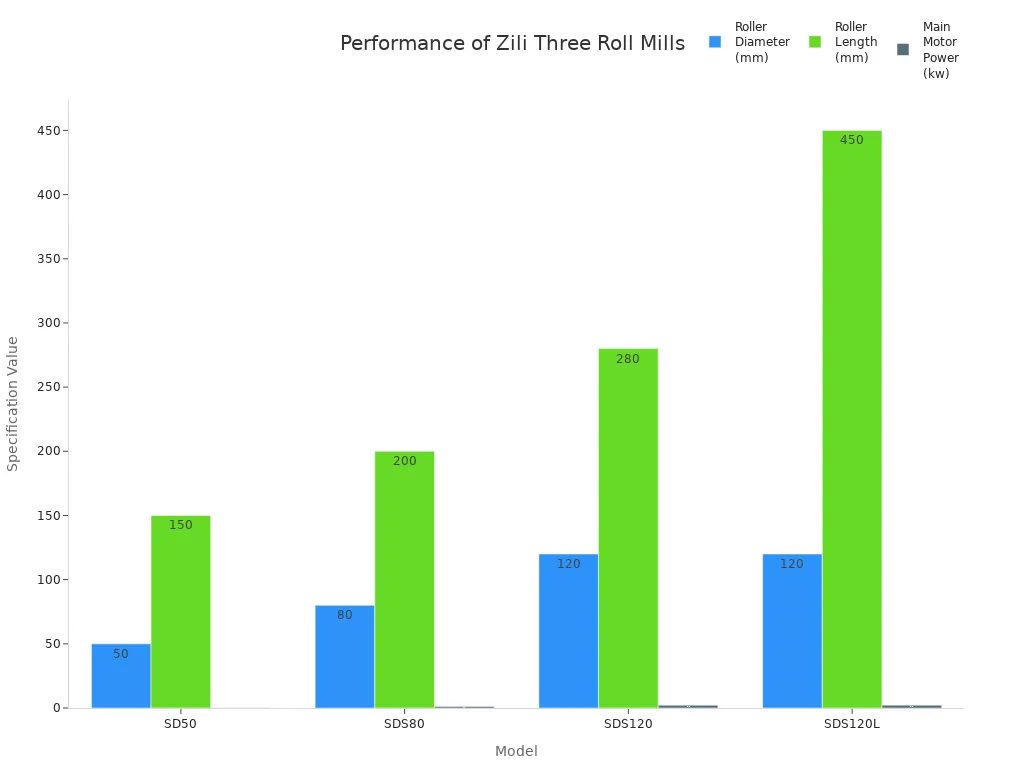
You use these mills for applications in nanotechnology, biotech, pharmaceuticals, and electronics R&D. You achieve consistent results and high-quality output with every batch.
You now understand how the three high rolling mill process boosts your production. You gain several key benefits:
You improve operational efficiency with continuous rolling.
You achieve better metallurgical stability for your products.
You reduce temperature gradients, which helps control deformation and scale.
Choose a three high or three roll mill when you need precise thickness, stable quality, and high output. Review your material needs and production goals to make the best choice.
FAQ
What materials can you process with a three high rolling mill?
You can process metals like steel, aluminum, and copper. You can also use these mills for electronic pastes, inks, and cosmetic materials. The mill works well with both hard and soft materials.
How do you adjust the gap between the rolls?
You use a control system or handwheel to set the gap. Many modern mills have digital controls for precise adjustments. This helps you achieve the exact thickness you need.
Why does the three high mill improve efficiency?
You do not need to stop or reverse the rolls. The material passes through two gaps in one cycle. This saves time and increases your output.
Is it easy to clean and maintain a three roll mill?
Yes! You can clean the rollers with a soft cloth and approved cleaning agents. Regular checks and lubrication keep the mill running smoothly. Many models have user-friendly designs for quick maintenance.


