


How does a triple roller mill Work
A triple roller mill works by passing high-viscosity material between three horizontally arranged rollers rotating at different speeds, creating shear force and pressure that break down particles into a smooth, fine dispersion. The three rollers are the feed roll, the center roll, and the apron roll. Each one plays a distinct part in the grinding process.
This article explains the mechanism behind the shear force, the step-by-step process inside the machine, and the specific role of each roller. Readers will also learn about common applications, material limits, and practical tips for setup, operation, maintenance, and safety.
Key Takeaways
A triple roller mill uses three rollers at different speeds to create shear force. This force breaks down particles into a smooth paste.
The three rollers work together: the feed roll accepts material, the center roll pre-grinds, and the apron roll applies the final high-shear pass.
Operators adjust the gaps between rollers to control particle size. Tighter gaps produce finer dispersion, down to 1-5 microns.
Cooling water circulates through each roller to prevent heat buildup. This protects temperature-sensitive materials like UV inks.
Triple roller mills handle high-viscosity materials for inks, electronics, cosmetics, and pharmaceuticals. Proper setup and maintenance ensure consistent quality.
How a Triple Roller Mill Creates Shear Force
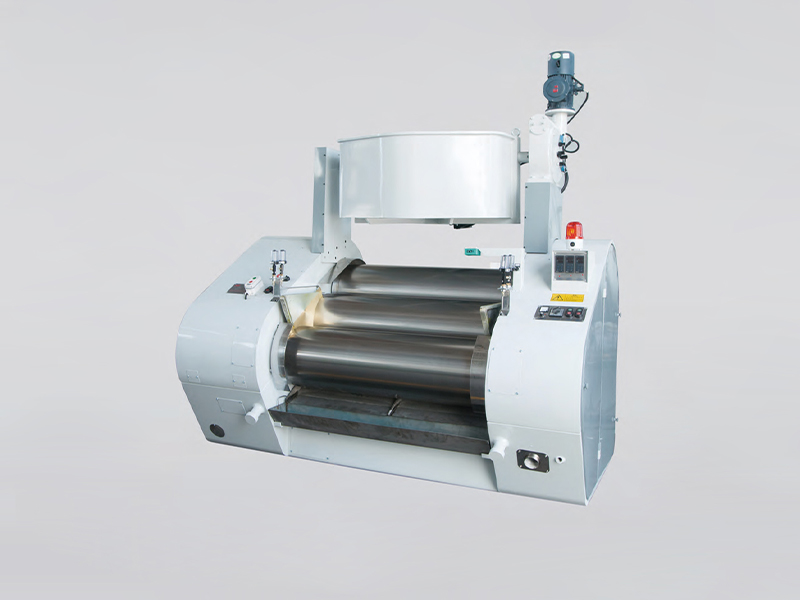
Roller Arrangement and Speed Ratios
Three rollers sit horizontally in a row. They rotate in opposite directions, a setup called counter-current rotation. The feed roll turns slowly. The center roll spins faster. The apron roll runs fastest of all. A typical triple roller mill uses a 1:3:9 speed ratio across these three rollers. That means if the feed roll turns at one unit of speed, the center roll turns at three units, and the apron roll turns at nine.
This speed difference creates shear force. Shear force is the sliding friction that happens when two surfaces move at different speeds and pull material apart. Think of spreading cold butter on toast. The knife slides across the surface and stretches the butter thin. A triple roller mill does the same thing to particles, but with far more force and precision.
Viscosity is a material's resistance to flow. Honey has high viscosity. Water has low viscosity. Triple roller mills handle high-viscosity materials that bead mills cannot process without clogging. The table below shows suitable viscosity ranges.
Viscosity Range (mPa·s / centipoise) | Processing Notes |
|---|---|
< 50,000 | May require gap mode; verify machine supports it |
50,000–500,000 | Standard pressure mode; most versatile range |
500,000–2,000,000 | Needs heavy-duty drive and reinforced frame |
Up to 2,000,000 | Maximum viscosity supported |
Gaps, Pressure, and Particle Breakdown
The gap between rollers controls how fine the final product becomes. Operators adjust these gaps to achieve different particle sizes. A tighter gap produces finer dispersion. The achievable fineness range runs from 3 to 18 microns. Gap precision reaches down to 1 micron. Some setups achieve sub-micron capability, meaning particles smaller than 1 micron.
The speed differential generates the grinding action. Material passes through the gap between the feed roll and center roll first. The center roll moves faster and pulls the material forward while the feed roll holds it back. This stretching action breaks down agglomerates. The material then moves to the gap between the center roll and apron roll. Here the speed difference is greatest, so the shear force is strongest. This final pass disperses particles evenly throughout the mixture.
Heat builds up during this process. Friction from high-speed rotation raises roller temperature. Uneven expansion would change the gap and ruin consistency. Cooling water circulates through each roller to stabilize its diameter. This keeps the gap steady during operation. Temperature-sensitive materials like UV inks depend on this cooling to prevent premature curing or degradation.
The combination of speed ratios, adjustable gaps, and cooling creates a controlled environment for particle breakdown. Each pass through the gaps refines the material further. The result is a smooth, uniform dispersion that meets tight specifications.
Step-by-Step Process Inside the Mill
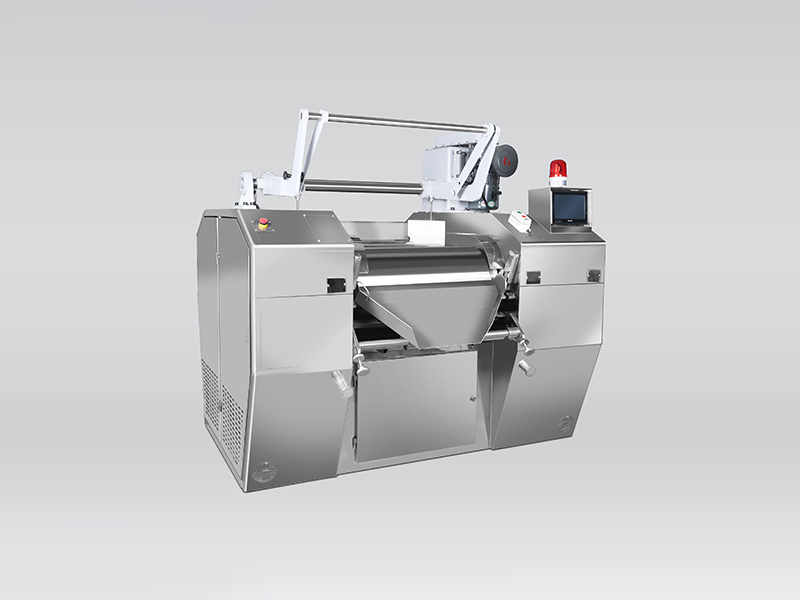
Feeding, Grinding, and Final Shearing
The process begins when an operator feeds material into the mill. The material enters the gap between the slow feed roll and the center roll. The feed roll turns slowly and holds the material back. The center roll spins faster and pulls the material forward. This speed difference creates the first stage of grinding. The rolls grip the material and reduce its thickness. Agglomerates start to break apart here.
The material then moves to the second gap. This gap sits between the center roll and the fast-spinning apron roll. The apron roll runs at the highest speed. The gap here is even smaller and faster-moving than the first one. Maximum shearing occurs at this nip. The two-stage shearing process is ideal for creating extremely fine dispersions. The material exits this final pass as a smooth, uniform paste.
The sequence follows a clear path through the machine:
The material is fed between the feed roll and the center roll first.
The rolls grip the material and reduce its thickness.
After the first pass, the material is guided back between the center roll and the apron roll.
The roll rotation direction allows this back-and-forth flow without reversing the rolls or the motor.
This design lets a triple roller mill handle high-viscosity materials with ease. The open-roller design also provides a large surface area for temperature control and outgassing. Outgassing matters because trapped air bubbles ruin dispersion quality. The open design lets those bubbles escape naturally.
The open-roller design of triple roll mills exposes a large surface area, which enables effective outgassing along with better temperature control when processing high-viscosity pastes.
Scraper Removal and Collection
A scraper knife removes the processed paste from the apron roll. The knife sits against the apron roll surface at a precise angle. As the apron roll spins, the knife scrapes the paste off in a continuous sheet. The paste then drops into a collection container or flows to the next production stage.
The scraper knife must stay sharp and properly aligned. A dull knife leaves paste on the roll and reduces yield. An misaligned knife can damage the roll surface or cause uneven removal. Operators inspect the knife regularly and replace it when wear appears.
Collection methods vary by production scale. Lab mills often use a simple tray or pan. Production mills may use a pump system to move the paste to a holding tank. The collected material is then tested for particle size and dispersion quality. If the results fall outside specifications, the operator adjusts the gap settings and runs the material through again.
The entire process — feeding, grinding, shearing, and scraping — happens continuously. Material flows through the mill in a steady stream. The operator monitors roller temperature, gap settings, and paste appearance throughout the run. This hands-on oversight ensures consistent output batch after batch.
The Role of Each Roller
Feed Roll, Center Roll, and Apron Roll
Each roller in a triple roller mill performs a specific job. The feed roll accepts material from the operator. It turns at the slowest speed and holds the material back. This slow rotation creates resistance against the faster center roll. The feed roll also starts the initial mixing action.
The center roll transfers material and performs pre-grinding. It spins three times faster than the feed roll. This speed difference pulls material through the first gap and breaks down large agglomerates. The center roll acts as a bridge between the slow feed stage and the fast final stage.
The apron roll applies the final high-shear pass. It runs at the highest speed, nine times faster than the feed roll. The gap between the center roll and apron roll is the narrowest. Maximum shearing occurs here. The apron roll delivers the finest dispersion before the scraper knife removes the paste.
Roller | Speed Ratio | Primary Function |
|---|---|---|
Feed Roll | 1 | Accepts material, holds it back |
Center Roll | 3 | Transfers material, pre-grinds |
Apron Roll | 9 | Applies final high-shear pass |
Why Three Rollers Beat One or Two
Three rollers provide progressive grinding. A single roller cannot create shear force because shear requires two surfaces moving at different speeds. Two rollers create one shearing zone. Three rollers create two shearing zones in series. The material passes through both zones during one cycle.
This progressive approach produces finer dispersion. The first gap breaks down large particles. The second gap refines smaller particles further. Each stage reduces particle size more effectively than a single pass could achieve.
Temperature management also improves with three rollers. Heat builds up during grinding. Spreading the work across three rollers distributes the heat load. The cooling system removes heat from each roller individually. This protects temperature-sensitive materials from thermal damage.
The three-roller design delivers consistent dispersion quality. Operators adjust each gap independently. This control allows precise tuning for different materials and particle-size targets.
Applications and Materials for Triple Roller Mills
Industries That Rely on Three Roll Mills
Many manufacturing sectors depend on triple roller mills for high-viscosity dispersion. The printing industry uses these machines for offset and gravure inks, UV-curable inks, anti-counterfeit inks, and packaging inks. High-precision grinding refines pigment particles for better color saturation, gloss, and adhesion. Electronics manufacturers process silver, aluminum, nickel, copper, and platinum slurries, along with solder paste and functional inks. Strict particle distribution control ensures conductivity and reliability in these applications.
Manufacturing Sector | High-Viscosity Dispersion Application |
|---|---|
Printing & UV Ink | UV-curable, anti-counterfeit, packaging, sheet-fed and offset inks |
Electronic Slurry | Silver, aluminum, nickel, copper and platinum slurry, solder paste |
Functional Materials | Sealants, adhesives, lubricants, ceramic slurry, composite materials |
Cosmetics & Personal Care | Lipstick, sunscreen, foundation, hair wax |
Chemical / Light Industry | Oils, coatings, pigments, color paste, vegetable gum, soap |
Other industries include pharmaceuticals for ointments, cosmetics for foundations and lipstick, and food production for chocolate paste. Soap noodles, grease, and specialty chemicals also rely on this equipment.
Particle Size and Viscosity Limits
Three roll mills achieve fineness down to 3–18 microns, with sub-micron capability for demanding applications. They handle viscosities up to 2,000,000 cPs without the media clogging issues common in bead mills. This makes them ideal for high-viscosity pastes that other grinding equipment cannot process efficiently.
Zili, a manufacturer based in Changzhou, China, offers a complete range of three roll mills. The Lab SDS Series supports formulation research and precise data scaling. Hydraulic SYS Production Lines deliver uniform particle size reduction for large-scale manufacturing. Manual Mills provide cost-effective options for traditional production. Specialty configurations include zirconia or alumina ceramic rollers for metal-free environments, which suit contamination-sensitive electronic pastes. Dual-metal alloy rollers offer surface hardness up to HS 70–75. A dynamic water cooling system circulates water through each roller to protect temperature-sensitive materials like UV inks. Sanitary stainless steel casings serve cosmetics and pharmaceutical applications where hygiene is critical.
Setup, Operation, Maintenance, and Safety
Operators adjust a triple roller mill before every production run. The machine demands precise settings for each material.
Adjusting Gaps, Speeds, and Cooling
Gap adjustment starts between the feed roll and the center roll. This first gap handles large agglomerates. The second gap, between the center roll and the apron roll, controls final fineness. Tighter gaps produce finer dispersion, down to 3–18 microns. Operators make small adjustments, run test batches, and check particle size with a grind gauge until the material meets specification.
Speed settings follow a fixed ratio on most machines: 1:3:9 across the feed, center, and apron rolls. Some mills allow variable speed control. Operators match speed to material viscosity. Stiffer pastes need slower speeds to prevent overheating. Softer materials can run faster without damage.
Cooling water circulates through each roller during operation. Friction generates heat inside the gaps. Heat expands the rollers and changes the gap, ruining consistency. The dynamic cooling system removes heat continuously. This protection matters for temperature-sensitive materials like UV inks. UV inks cure when heated. Cooling keeps them stable during grinding.
Cleaning, Roller Care, and Safety Features
Cleaning keeps a three roll mill accurate. Operators remove the scraper knife first. They wash each roller with a suitable solvent. The solvent depends on the material; inks require different solvents than cosmetics. Operators wipe all paste from the roller surfaces and dry them completely. They inspect roller faces for scoring, pitting, or chips. Damaged rollers produce uneven gaps. Operators replace worn scrapers and check knife alignment. A dull knife leaves paste on the apron roll and wastes product.
Safety features protect the operator during daily use. Emergency stop devices halt all rollers instantly. These stops sit within easy reach. Guards prevent hands from entering the roller nip. Operators never touch moving rollers. Cleaning and maintenance happen only after the machine stops. Lockout procedures secure the mill during service. Hydraulic models include pressure relief systems. Routine inspection of cooling lines and hydraulic hoses prevents sudden failure.
Proper setup and care keep a three roll mill producing consistent output. Technicians who follow these steps extend roller life and maintain dispersion quality.
A triple roller mill relies on three rollers rotating at different speeds and adjustable gaps to create shear force. That force disperses and refines high-viscosity materials into uniform pastes.
The three-roller design matters because it grinds progressively. Each roller pair works in sequence, so operators control gap precision to hit strict particle-size targets. This consistency makes the mill dependable for inks, electronic pastes, cosmetics, and pharmaceuticals.
Operators should match roller settings to material viscosity and desired fineness. Tighter gaps produce finer results; slower speeds protect heat-sensitive products. Buyers should confirm cooling capacity and roller material match their application. Demand for fine, uniform pastes will keep this equipment essential in advanced manufacturing.
FAQ
What materials can a triple roller mill process?
A triple roller mill handles high-viscosity materials such as inks, electronic pastes, cosmetics, pharmaceuticals, grease, chocolate paste, ointments, and soap noodles. It works best with pastes that resist flow. The machine processes viscosities up to 2,000,000 cPs without clogging issues common in bead mills.
How fine can a triple roller mill grind?
Operators achieve particle fineness down to 3–18 microns with standard settings. Some configurations reach sub-micron capability for demanding applications. The adjustable gap between rollers controls the final particle size. Tighter gaps produce finer dispersion.
Why do triple roller mills use three rollers instead of two?
Three rollers create two shearing zones in series. The first gap breaks down large agglomerates. The second gap refines particles further. This progressive grinding produces finer, more uniform dispersion than a single shearing pass. Heat also distributes across three rollers for better temperature control.
What cooling system do triple roller mills use?
A dynamic cooling system circulates water through the full length of each roller. This stabilizes roller diameter and prevents uneven expansion that would change the gap during operation. Cooling protects temperature-sensitive materials like UV inks from premature curing or degradation during high-friction grinding.
How do operators clean a triple roller mill?
Operators remove the scraper knife first, then wash each roller with a suitable solvent. The solvent choice depends on the processed material. They wipe all paste from roller surfaces, dry them completely, and inspect for scoring or pitting. Damaged rollers produce uneven gaps and inconsistent dispersion.


