


How does a 3 roll mill work
You use a 3 roll mill to mix and refine thick, sticky materials with high precision. This machine has three rollers that spin at different speeds. These rollers pull your material through, grinding it with strong shear force and pressure. You get smooth, even results every time. Industries like inks, cosmetics, and pharmaceuticals rely on this process to create products with fine, uniform textures. The table below shows how a 3 roll mill achieves stable and uniform dispersion, reaching fineness levels as low as 3–18 μm.
Feature | Industrial Triple Roller Mill |
|---|---|
Grinding Method | Shear force & pressure grinding |
Suitable Materials | High-viscosity paste materials |
Typical Fineness | 3–18 μm |
Dispersion Quality | Uniform and stable |
Operation | Manual or hydraulic adjustment |
Key Takeaways
A 3 roll mill uses three rollers to mix and refine thick materials, achieving smooth and even results.
Adjustable gaps between rollers allow for precise control over particle size, reaching fineness levels as low as 3–18 μm.
The mill operates efficiently with high-viscosity materials, making it ideal for industries like inks, cosmetics, and pharmaceuticals.
Cooling systems within the rollers protect sensitive materials from heat damage during processing.
Regular maintenance and proper setup are crucial for optimal performance and safety when using a 3 roll mill.
3 Roll Mill Mechanism
Roller Arrangement
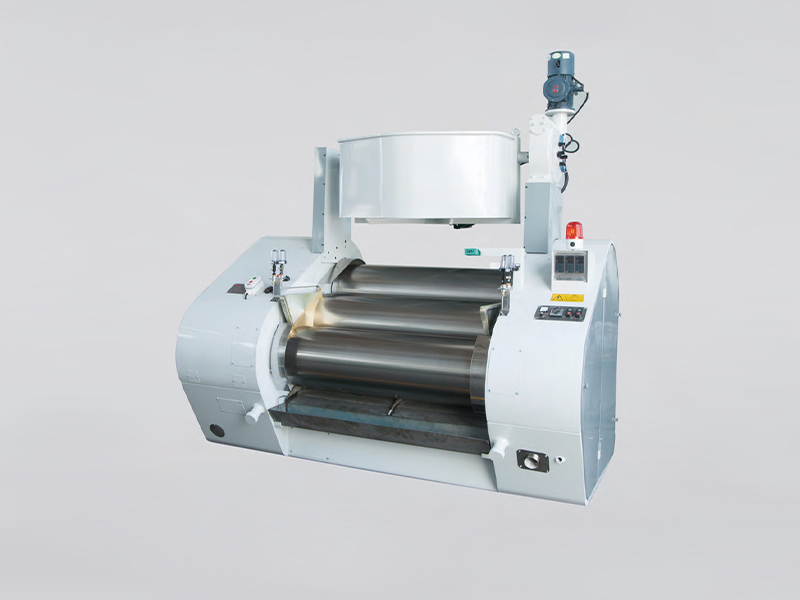
You see three rollers lined up horizontally in a 3 roll mill. Each roller spins at a different speed. This setup helps you process thick materials efficiently. The rollers create two gaps. The first gap sits between the feed roll and the center roll. The second gap sits between the center roll and the apron roll. You can adjust these gaps to match the material you want to refine.
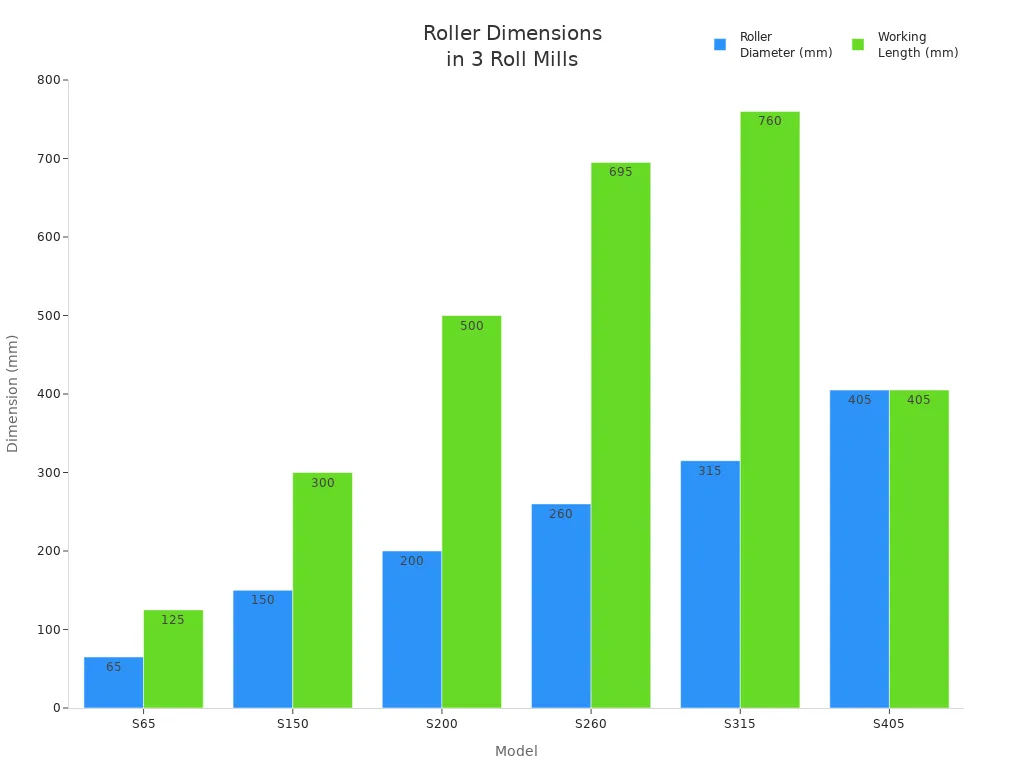
The rollers come in different sizes. Small lab mills use rollers as little as 50 mm in diameter. Large industrial mills use rollers up to 400 mm or more. The working length also changes with the model. For example, the S65 model has a 65 mm roller diameter and a 125 mm working length. The S405 model uses a 405 mm roller diameter and a 405 mm working length. The speed ratio changes with each model, making the process flexible for different materials.
Model | Roller Diameter (mm) | Working Length (mm) | Speed Ratio |
|---|---|---|---|
S65 | 65 | 125 | 1:2.8:7.8 |
S150 | 150 | 300 | 1:2.5:6 |
S200 | 200 | 500 | 1:2.8:8.1 |
S260 | 260 | 695 | 1:2.8:8.1 |
S315 | 315 | 760 | 1:2.8:8.1 |
S405 | 405 | 405 | 1:3:9 |
You benefit from this arrangement because it allows continuous operation. You do not need to reverse the motor direction. The two gaps improve energy efficiency and throughput. You can clean the rollers quickly and switch between batches with ease.
Tip: Adjustable gaps and different roller materials help you handle many types of substances, from sticky pastes to sensitive electronic materials.
Shear Force and Material Movement
You feed your material into the slowest roller. The feed roll pulls the material in and starts the process. The center roll spins faster. It creates strong shear force. This force breaks down particles and spreads them evenly. The apron roll spins fastest. It finishes the grinding and dispersing, giving you a smooth, refined product.
Roller Position | Speed Ratio | Shear Force Impact |
|---|---|---|
Feed | Slowest | Initial material entry and feeding |
Center | Medium | Significant shear dispersion occurs |
Apron | Fastest | Final grinding and dispersing effect |
The gaps between the rollers compress and shear the material. The first gap applies compression. The second gap applies greater shear. You can adjust the spacing to reach the fineness you need. Many mills achieve gap precision down to 1 µm. Cooling systems inside the rollers keep the temperature stable. This protects sensitive materials from heat damage.
Principle | Description |
|---|---|
Configuration | The mill consists of three horizontally aligned rollers that rotate at different speeds. |
Shear Forces | The rollers create controlled shear forces that process viscous materials effectively. |
Compression | The first gap between the feed roll and center roll applies compression to break down particles. |
Dispersion | The second gap between the center roll and apron roll applies greater shear for finer dispersion. |
Adjustable Gaps | Roller spacing can be adjusted for different materials and particle sizes. |
Cooling/Heating Systems | Internal water channels regulate temperature to prevent thermal degradation of sensitive materials. |
Material Compatibility | Rollers can be made from various materials to handle different types of substances. |
Ease of Cleaning | The design allows for quick cleaning and changeovers between batches. |
You see the 3 roll mill mechanism working best when you need uniform dispersion and fine particle size. The combination of roller arrangement and shear force gives you control and precision. You can process inks, cosmetics, and electronic pastes with confidence.
Process Steps
Feeding Materials
You start by feeding your material into the 3 roll mill. Most materials you use are thick and sticky, like paste, ink, pigment, or adhesive. These materials have high viscosity, often over 100,000 cP. You place the material on the feed roll, which rotates at the lowest speed. This roll pulls the material in and spreads it evenly. You can see the typical materials and their viscosities in the table below:
Material Type | Typical Viscosity |
|---|---|
Paste | High-viscosity |
Pigment | High-viscosity |
Ink | High-viscosity |
Adhesive | High-viscosity |
Ointment | High-viscosity |
Tip: Always check the thickness of your material before feeding. You want a thickness between 3–10 mm for best results.
Dispersion and Grinding
Once your material enters the mill, the center roll takes over. This roll spins faster than the feed roll. It applies strong shear force and pressure. The center roll reduces the size of dry particles and wets them. The apron roll, which spins fastest, finishes the process. It exerts the highest shear force in the final gap. You can see the stages and roll types in the table below:
Stage | Roll Type | Description |
|---|---|---|
01 | Feed Roll | Material enters here, rotating at the lowest speed. |
02 | Center Roll | Medium speed, reduces particle size and wets dry particles. |
03 | Apron Roll | Fastest speed, highest shear force for final dispersion. |
You control the speed and gap between the rolls. This lets you adjust how much force is applied. Cooling systems keep the temperature low, protecting your material from overheating.
Output and Fineness
After grinding, your material exits the mill. You collect the finished product from the apron roll. You measure fineness by adjusting the gap between the rollers. Smaller gaps give you finer particles. Most mills achieve a fineness range of 3–18 μm. This level of control helps you produce inks, coatings, and other products with consistent quality.
Process Step | Description | Key Parameters | Outcome |
|---|---|---|---|
Entry Section | Material enters the mill; thickness measured. | Thickness: 3-10 mm; Speed: 0.5-1 m/s | Proper alignment for processing. |
Rolling | Rolls reduce thickness and grind material. | Roll Force: 2000-5000 kN; Speed: up to 10 m/s | Thickness reduction to desired gauge. |
Cooling | Material cooled to prevent overheating. | Temperature: below 50°C | Improved surface quality. |
Finishing | Final adjustments for flatness and quality. | Surface Roughness: Ra < 0.5 µm | Product ready for delivery. |
Note: You can achieve very fine dispersion by adjusting the roller gap. This gives you control over the final quality.
Roll Functions
Feed Roll
You start with the feed roll. This roller sits at the entry point of the 3 roll mill. You place your material here. The feed roll rotates at the slowest speed. It pulls thick paste or pigment into the machine. You see the material spread evenly across the surface. The feed roll helps you control the amount of material entering the mill. You can adjust the gap between the feed roll and the center roll. This adjustment lets you decide how much pressure to apply. You get consistent feeding, which is important for uniform grinding.
Tip: Always check the surface of the feed roll. Clean it before each batch to avoid contamination.
Center Roll
The center roll plays a key role in the grinding process. It spins faster than the feed roll. You notice that the center roll creates strong shear forces. These forces break down clumps and mix the material thoroughly. The center roll works with the other two rolls to produce differential rotation. This action generates continuous and high-intensity shear forces. You see uniform dispersion because the center roll grinds agglomerated particles effectively.
The center roll rotates at medium speed.
It receives material from the feed roll.
Shear forces from the center roll help achieve fine particle size.
The combined action of all three rolls ensures even mixing.
You can adjust the gap between the center roll and the discharge roll. This adjustment gives you control over the final fineness.
Discharge Roll
The discharge roll, also called the apron roll, spins at the highest speed. You collect the finished product from this roller. The discharge roll applies the final shear force. It ensures that your material leaves the mill smooth and refined. You can scrape the product off the discharge roll easily. This roll helps you achieve the desired texture and quality. You see the results immediately as the material exits the mill.
Roll Type | Speed | Function | Adjustment |
|---|---|---|---|
Feed Roll | Slowest | Material entry and spreading | Gap |
Center Roll | Medium | Shear force and dispersion | Gap |
Discharge Roll | Fastest | Final grinding and product output | Gap |
Note: Each roll has a specific job. You get the best results when you adjust the gaps and speeds for your material.
3 Roll Mill Applications
Industry Uses
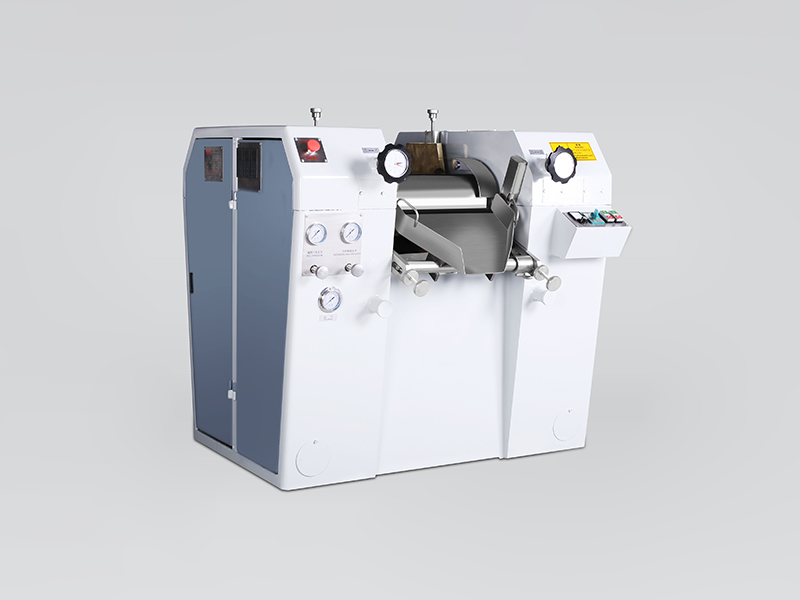
You can use a 3 roll mill in many industries that need smooth, fine, and even products. In the ink industry, you use the mill to mix pigments and oils. This gives you bright colors and a uniform texture. In the electronics field, you process conductive pastes and electronic materials. The mill helps you reach the tiny particle sizes needed for high-tech devices. Cosmetic companies use the mill to blend creams, lotions, and pastes. You get silky, lump-free products that feel good on the skin. In the pharmaceutical industry, you use the mill to mix ointments and gels. This ensures every batch is safe and consistent.
Zili's High-Precision Three Roll Mills work well in all these areas. You can trust them to deliver the same quality every time. The intelligent closed-loop control system keeps particle size deviation within ±5%. The V-roll system covers 90% of grinding needs. You can adjust the mill to meet special requirements, like making silver paste for electronics or shaping particles for cosmetics.
Material Types
You can process many types of materials with a 3 roll mill. Thick pastes, sticky adhesives, and high-viscosity inks move smoothly through the rollers. The mill also handles sensitive materials, such as those used in electronics and medicine. You can achieve sub-micron fineness, which means particles smaller than one micron.
Here is how Zili's High-Precision Three Roll Mills help you:
Feature | Benefit |
|---|---|
Precise gap control | You can make fine adjustments to reach sub-micron particle sizes. |
Efficient cooling systems | You prevent overheating, which is important for thick materials. |
Optimized roll materials | You get strong, long-lasting rollers for tough, sticky substances. |
Tip: You can use ceramic rollers for materials that must stay metal-free, like some electronic pastes or cosmetics.
You can rely on Zili's mills for both research and large-scale production. You get flexibility and control for every batch.
Practical Considerations
Setup and Operation
You start by placing your 3 roll mill on a stable, level surface. Make sure the area is clean and free from clutter. Zili’s High-Precision Three Roll Mills come with a user-friendly interface. You can set roller speed, gap distance, and cooling options with simple controls. Choose the right roller material for your product. Alloy rollers work well for most pastes. Ceramic rollers, like Zirconia or Alumina, are best for metal-free or sensitive materials. Zili’s advanced hydraulic system lets you adjust pressure quickly and evenly. You protect temperature-sensitive materials by using the built-in cooling system. This keeps your product safe from overheating during grinding.
Tip: Always check the roller gap before starting. Small changes can make a big difference in your final product.
Maintenance Tips
You keep your 3 roll mill in top shape by following a few key steps:
Select high-quality rollers and clean them after each use. This prevents debris from building up.
Prepare your feedstock well. Make sure it is mixed and has the right thickness for smooth milling.
Adjust the gap between the rolls to get the particle size you want. Watch energy use as you make changes.
Set the roller speed for good grinding. Avoid running the mill too fast, which can cause overheating or wear.
Zili offers strong after-sales support. You can get help with troubleshooting, spare parts, and regular check-ups.
Safety Guidelines
You stay safe by following these rules:
Make sure only trained workers use forklifts or move heavy parts.
Use proper lifting methods to keep your balance and avoid falls.
Move rolls slowly and carefully to prevent shifting.
Store rolls in a safe, marked area away from hazards.
Train everyone on safety steps and emergency plans.
Check all handling tools and machines often.
Talk with your team during operations to avoid mistakes.
Look for risks before you start moving or handling equipment.
Note: Good safety habits protect you and your team. Regular training and checks help prevent accidents.
You see how a 3 roll mill uses three rollers to mix, grind, and refine thick materials. You control the process steps and adjust each roll for the best results. Zili’s high-precision mills help you achieve consistent quality. The table below shows the main benefits you get:
Benefit | Description |
|---|---|
Precise Control of Particle Size | Achieve final particle sizes between 3 and 18 micrometers, crucial for consistent product quality. |
Uniform Dispersion | Ensures even distribution of materials, vital for inks and coatings. |
Efficiency with High-Viscosity | Handles thick pastes and slurries effectively, maintaining quality and consistency. |
Protection of Temperature-Sensitive | Dynamic cooling prevents heat damage to sensitive materials. |
Prevention of Metal Contamination | Ceramic rollers avoid contamination, important for sensitive applications. |
Versatility Across Industries | Used in inks, cosmetics, pharmaceuticals, and more, showcasing its broad applicability. |
Explore Zili’s advanced grinding solutions to improve your production and meet your industry needs.
FAQ
What materials can you process with a 3 roll mill?
You can process thick pastes, inks, adhesives, cosmetics, and electronic materials. The mill works well with high-viscosity substances. You can also use it for temperature-sensitive or metal-free products by choosing the right roller material.
How do you clean a 3 roll mill?
You should clean the rollers after each batch. Use a soft cloth and a suitable solvent. Remove all leftover material. This keeps your mill in good condition and prevents contamination.
Why do you need different roller materials?
Different materials need different rollers. Alloy rollers work for most pastes. Ceramic rollers help when you want to avoid metal contamination. You choose the roller based on your product’s needs.
How do you control the particle size?
You adjust the gap between the rollers. A smaller gap gives you finer particles. Zili’s mills let you set the gap with high precision, so you get the exact fineness you want.
Is it safe to operate a 3 roll mill?
Yes, if you follow safety rules. Always use proper lifting methods. Keep the area clean. Train everyone on safe operation. Zili’s mills include safety features to help protect you and your team.


