


What is a laboratory sand mill
A laboratory sand mill is a compact, batch-operated wet grinding device. It finely grinds and disperses solid particles in a liquid medium. Researchers use this equipment for research and development, small-scale testing, and formulation work. The industry also calls it a lab bead mill or vertical bead mill. These machines help scientists prepare small samples with precision. They mix solid particles into liquids and break down clumps. This process creates smooth, uniform mixtures. Formulators rely on these devices to test new recipes before full production. The compact size suits benchtop work in labs. It handles many materials, from pigments to advanced compounds. Small batches allow quick trials without wasting expensive ingredients.
Key Takeaways
Lab sand mills use small batches to test formulas without wasting costly materials.
Engineers scale down production mill geometry to predict industrial results accurately.
Operators clean the detachable chamber in under 10 minutes for quick formulation changes.
The equipment grinds particles to ultra-fine sizes for paints, inks, and pharmaceuticals.
Cooling systems protect heat-sensitive materials and ensure consistent test data.
Key Components of a Laboratory Sand Mill
A laboratory sand mill contains several core parts that work together. These parts include the grinding chamber, agitator, grinding media, motor, and cooling system. Each component plays a specific role in the grinding and dispersing process.
Grinding Chamber and Agitator
The grinding chamber holds the material and the grinding media. The agitator spins inside this chamber. Its rotation creates motion that breaks down particles. Chamber and agitator materials must resist wear and prevent contamination. Interchangeable chamber and agitator materials are available. These options include stainless steel, tungsten carbide, and ceramic materials such as zirconia or alumina. This design prevents cross-contamination in sensitive chemical formulations.
Standard grinding tank volumes for small-batch research include 0.5L and 1L. These sizes minimize material consumption during testing. Researchers can run multiple trials without wasting expensive ingredients.
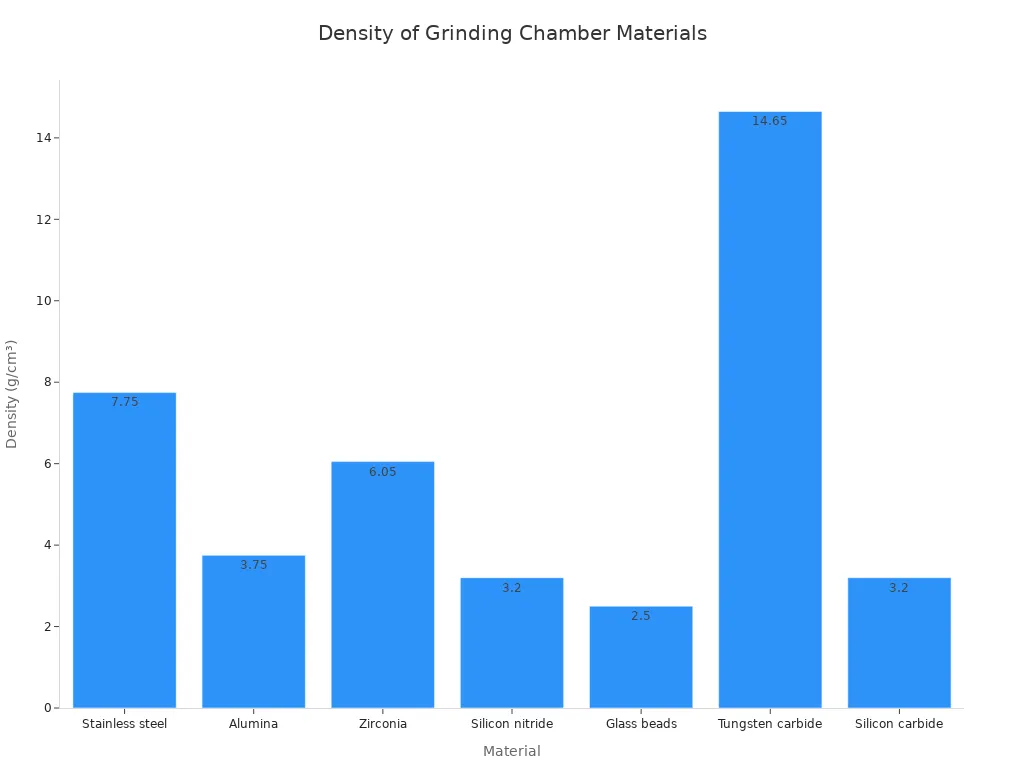
Material selection depends on the application. The table below compares common options.
Material | Key Properties | Best Use |
|---|---|---|
Stainless steel (440C, 304/316) | 440C: 58–63 HRC, 7.75 g/cm³, good corrosion resistance; austenitic grades softer, non-magnetic, highly corrosion resistant | Wet milling of food, pharmaceuticals, chemicals where rust contamination is unacceptable but ceramic cost is not justified |
Alumina (Al₂O₃) | 92–99% purity, 3.6–3.9 g/cm³, near Mohs 9, resists acids/alkalis, stable above 1000 °C | Ceramic raw materials, minerals, paints, general-purpose milling with low contamination at moderate cost |
Zirconia (yttria-stabilized, YTZ) | 6.0–6.1 g/cm³, high fracture toughness, negligible wear debris, chemically inert | Ultra-fine/nano grinding, contamination-critical milling, pharmaceutical APIs, food, battery materials |
Silicon nitride (Si₃N₄) | ~3.2 g/cm³, ~1550 HV, chemically inert, high-temperature stable | Specialty high-purity milling, advanced ceramics, maximum wear resistance at low density |
Glass beads | Soda-lime: 2.5 g/cm³, ~Mohs 6; borosilicate adds chemical/thermal resistance | Paints, pigments, dyes, inks where gentle action and zero metallic contamination matter |
Tungsten carbide | 14.3–15.0 g/cm³, Mohs 9–9.5, highest-energy media, brittle relative to steel | Ultra-fine milling of hardest, most abrasive feeds in controlled conditions |
Silicon carbide | ~3.2 g/cm³, Mohs 9+ | Abrasive specialty grinding |
Grinding Media and Cooling System
Grinding media are small beads that collide with particles. Zirconia beads are a common choice. They offer high density and minimal wear debris. The motor drives the agitator at controlled speeds. A cooling system removes heat generated during grinding. This heat control protects temperature-sensitive materials.
Material choice affects performance and contamination risk. Consider these options:
Stainless steel — suitable for general use; must be compatible with the product to avoid contamination.
Tungsten carbide — chosen for high wear resistance.
Ceramic materials (zirconia or alumina) — used for metal-free grinding; preferred for sensitive materials, with fully ceramic options often recommended.
The cooling system maintains stable temperatures throughout the batch. This stability ensures repeatable results across multiple test runs.
How a Laboratory Sand Mill Works
A laboratory sand mill grinds particles through mechanical forces inside a closed chamber. The agitator spins at high speed. This motion drives the grinding media to collide with solid particles. The process reduces particle size and creates a uniform dispersion.
Shear and Impact Forces
The rotating agitator generates several distinct forces. Each force plays a specific role in breaking down agglomerates. The table below summarizes these forces and their scientific functions.
Force Type | Scientific Role in Particle Refinement |
|---|---|
Shearing force | Breaks up agglomerated particles and improves dispersion |
Collision force | Crushes large particles into finer ones |
Friction force | Further refines particle surfaces |
Extrusion force | Enhances particle crushing and homogenization |
The rotor, dispersion disc, or pin structure rotates at high speed. This rotation drives the grinding media, such as zirconia beads or glass beads, to move intensely within the grinding chamber. Material particles face repeated exposure to these combined forces. Particle size gradually decreases with a narrower distribution range after single-pass or circulating grinding.
Laboratory sand mills are used for formula development, sample testing and process verification.
Batch Grinding and Dispersion
A basket lab sand mill integrates pre-dispersion and grinding within a single paint slurry tank. This design offers three key operational advantages. Variable-speed spindle control ensures smooth, low-noise operation. An efficient color change procedure accelerates switching between formulations. Simplified maintenance makes cleaning and grinding media replacement easier.
A horizontal model allows for continuous processing of very small samples. This design ensures valuable active ingredients are not wasted in system dead-space. Researchers can process tiny batches without losing expensive materials.
Precision variable frequency drives (VFD) equip the lab sand mill. These drives enable researchers to test exactly how different RPMs and shear rates affect particle size distribution. Scientists can adjust speed parameters and observe the direct impact on grinding results. This capability helps them identify optimal processing conditions for each formulation.
The grinding process follows a predictable pattern. The agitator rotates and creates a vortex within the chamber. Grinding media tumble and collide throughout this vortex. Particles caught between media experience shear, impact, friction, and extrusion. The combined action breaks down agglomerates into primary particles. Repeated passes through the grinding zone further refine the material. The final product emerges as a stable, uniform dispersion with consistent particle size.
Temperature control remains critical throughout the process. The cooling system removes heat generated by friction and impact. This thermal management protects temperature-sensitive materials from degradation. Stable temperatures also ensure repeatable results across multiple test runs.
Researchers value this controlled environment. They can replicate industrial grinding conditions on a small scale. The data collected guides mass production parameter setting. This scalability makes the laboratory sand mill an essential tool for product development.
Lab Sand Mill vs. Production Sand Mill
Scale and Operation Mode
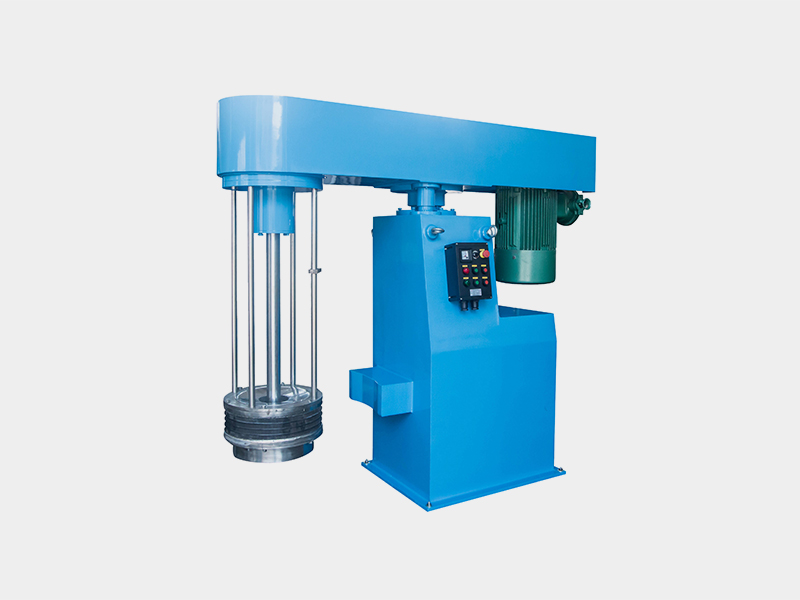
The primary difference between a lab sand mill and a production sand mill is scale. Lab units use grinding tanks with volumes of 0.5L or 1L. Production mills handle volumes measured in hundreds or thousands of liters. This size difference affects every aspect of operation.
Operation mode also differs. Laboratory sand mills typically run in batch mode. Researchers process one small sample at a time. This approach allows careful monitoring of grinding progress. Production mills often operate continuously. Material flows through the mill in a steady stream. Continuous processing maximizes throughput for manufacturing needs.
The table below summarizes the key differences.
Feature | Lab Sand Mill | Production Sand Mill |
|---|---|---|
Tank volume | 0.5L, 1L | Hundreds to thousands of liters |
Operation mode | Batch (one sample at a time) | Continuous (steady material flow) |
Primary use | R&D, formulation, small-scale testing | Mass production, large batches |
Scale-up design | Geometrically scaled down | Industrial size with matched energy density |
Despite size differences, the lab sand mill shares critical design features with industrial models. Engineers scale down geometry from production mills. They match energy density and peripheral speeds mathematically. Peripheral speed measures how fast the agitator tip moves through the grinding media. Energy density describes grinding energy applied per unit volume. Keeping these values consistent ensures predictable scale-up. Researchers run tests on a 0.5L lab mill and confidently predict results on a 1000L production mill. This mathematical relationship saves time and reduces risk during technology transfer.
The grinding mechanism remains identical across scales. Both lab and production mills use the same principles of shear, impact, friction, and extrusion forces. Both require proper selection of grinding media material and size. Both need effective cooling systems to manage temperature. This consistency means researchers optimize parameters at lab scale and apply them directly to production.
Variable Control and Flexibility
Variable-speed spindle control gives the lab mill significant advantages for formulation work. The operator adjusts spindle speed smoothly across a wide range. This capability allows exploration of different shear conditions. Researchers test how particle size changes with RPM. They find the optimal speed for each formulation before scaling up.
Precision variable frequency drives enable this speed control. These drives maintain stable rotation regardless of load changes. The spindle runs quietly and smoothly at any set speed. Low-noise operation matters in laboratory environments where multiple tests run simultaneously.
Variable control also simplifies color changes between formulations. Production mills often require lengthy cleaning procedures between batches. Residue from one pigment contaminates the next formulation. The lab mill's detachable grinding chamber solves this problem. Operators remove the chamber, clean it thoroughly, and reassemble the mill within minutes. This quick changeover allows researchers to test multiple formulations in a single day.
The lab mill also offers flexibility in grinding media selection. Different applications require different media sizes and materials. The operator changes media easily to suit each experiment. Choosing smaller media may produce finer particles. Switching from glass beads to zirconia beads reduces contamination risk. This flexibility lets researchers optimize every variable independently.
Control over cooling parameters adds another layer of flexibility. The operator adjusts coolant flow rate and temperature. This control protects heat-sensitive materials during grinding. Some formulations require strict temperature limits. The operator maintains those limits throughout the batch.
Together, these features make the lab sand mill a versatile research tool. It provides the control and flexibility needed to develop robust formulations. The data collected guides mass production decisions with confidence. Researchers rely on this equipment to perfect formulas before full-scale manufacturing begins.
Common Applications
Paints, Inks, and Coatings
A laboratory sand mill serves many industries that need fine particle dispersion. Paint manufacturers use it to grind pigments into smooth, uniform mixtures. Ink producers rely on it to create vibrant, consistent colors for printing. Coating formulators depend on it to achieve the right texture and finish. Battery researchers use it to prepare electrode slurries with precise particle sizes. Food scientists grind ingredients for stable emulsions. Chemical companies process raw materials into finished products. Each application benefits from the mill's ability to break down agglomerates and create stable dispersions.
The equipment achieves ultra-fine grinding down to 0.1μm. This precision makes it ideal for coatings, inks, and pigments. According to the POLYC technical specifications guide, laboratory-scale bead mills achieve a target fineness of sub-micron down to 100 nm. This capability allows formulators to create products with superior smoothness and color intensity. Smaller particles also improve stability and prevent settling during storage.
Pharmaceuticals and Nanomaterials
Pharmaceutical companies use this equipment to grind active ingredients into fine powders. Smaller particles dissolve faster in the body. This improves drug absorption and bioavailability. Bio-chemical researchers prepare formulations for testing new drug delivery systems. They need precise control over particle size to ensure consistent results. The mill's cooling system protects heat-sensitive compounds from degradation during processing.
Nanomaterial research demands even finer grinding. Scientists work with particles measured in nanometers. They study how size affects material properties like strength, conductivity, and reactivity. University labs use the mill for nanoparticle research and prototyping. Material science R&D teams develop new composites and advanced materials. These researchers need reliable equipment that produces repeatable results. The laboratory sand mill provides the control and precision they require for cutting-edge work.
Advantages of a Lab Sand Mill
Efficiency and Reproducibility
A laboratory sand mill delivers stable, repeatable test data that simulates industrial grinding processes. Researchers run the same formulation multiple times and compare results. The precision variable frequency drives maintain consistent spindle speeds across every batch. This consistency eliminates variables that could skew test outcomes. Scientists trust the data because the equipment performs identically each run. They use this information to guide mass production parameter setting with confidence.
Low power consumption keeps operating costs manageable for research budgets. The compact motor draws minimal electricity compared to full-scale production equipment. Minimal material consumption further reduces expenses. Standard tank volumes of 0.5L and 1L allow testing with small quantities of expensive ingredients. Pharmaceutical researchers testing costly active compounds appreciate this efficiency. Battery material scientists preserve valuable precursor materials during formulation trials. The mill processes these small batches without waste.
Small Samples and Easy Cleaning
The detachable grinding chamber simplifies the cleaning process significantly. Operators remove the chamber quickly and rinse all components thoroughly. Full rinsing is quick. This rapid turnaround prevents cross-contamination between formulations. Researchers testing multiple pigment dispersions in sequence avoid color carryover. Pharmaceutical teams switching between different active ingredients maintain sample purity. The quick disassembly structure makes this possible without specialized tools.
Simplified maintenance extends the equipment's useful life. Operators replace grinding media easily when switching between applications. They access internal components without dismantling the entire machine. Cleaning between batches requires minimal effort. This design supports multi-formula experiments in a single workday. University labs running student projects benefit from the straightforward upkeep. Material science R&D teams maintain tight experiment schedules because cleaning does not delay their work. The mill stays ready for the next formulation with minimal downtime.
A laboratory sand mill provides reliable data for scaling formulations to full production. Its compact batch design enables fast testing with minimal material waste. Researchers achieve repeatable results that mirror industrial grinding conditions. This predictability guides mass production parameter setting without costly trial-and-error.
The equipment supports innovation across many diverse industries. It accelerates the research cycle for new coatings, pharmaceuticals, battery materials, and advanced compounds. Material science teams depend on consistent performance for formulation breakthroughs. The ability to process small batches quickly reduces overall development time.
Looking ahead, grinding and dispersion remain essential for successful product creation. This versatile tool plays a vital role in developing tomorrow's advanced materials. Its importance continues to grow with each new industry challenge.
FAQ
What tank sizes does a laboratory sand mill offer?
Standard grinding tank volumes include 0.5L and 1L. These small sizes minimize material consumption during testing. Researchers can run multiple trials without wasting expensive ingredients.
What grinding media work best in a lab sand mill?
Zirconia beads are a common choice. They offer high density and minimal wear debris. Glass beads suit gentle applications. Tungsten carbide provides high wear resistance. The operator selects media based on the formulation and contamination risk.
How fine can a laboratory sand mill grind particles?
The equipment achieves ultra-fine grinding down to 0.1μm. This precision makes it ideal for coatings, inks, and pigments. Smaller particles improve stability and prevent settling during storage.
Can a lab sand mill predict production results?
Yes. Engineers geometrically scale down the lab mill from industrial models. They match energy density and peripheral speeds mathematically. Researchers run tests on a small mill and confidently predict results on a large production mill.
How long does cleaning take between formulations?
Full rinsing is quick. The detachable grinding chamber allows quick removal and thorough cleaning. This rapid turnaround prevents cross-contamination between formulations. Researchers test multiple pigment dispersions in sequence without color carryover.


