


What is a triple roll mill
A triple roll mill is a dispersion machine that passes thick, sticky materials through three rollers turning at different speeds. Also called a three roll mill or triple roller mill, it refines high-viscosity pastes with high precision. The feed, center, and apron rollers rotate at different speeds, and the material moves through shear and pressure, as IDA Equipment describes. The design needs no grinding media, so the mixture stays free of contamination. Manufacturers rely on this machine when dispersion quality directly shapes the finished product. This article explains the working principle, key components, common applications, advantages, and selection factors.
Key Takeaways
A triple roll mill uses three rollers spinning at different speeds to break down particles in thick pastes.
Tightening the gap between rollers makes the paste finer; loosening it speeds up production.
This mill works best for high-viscosity materials like inks, paints, and cosmetics.
Ceramic rollers prevent metal contamination, which is crucial for electronics and pharmaceuticals.
Choose a triple roll mill when you need precise particle size control for thick pastes.
How a triple roll mill works
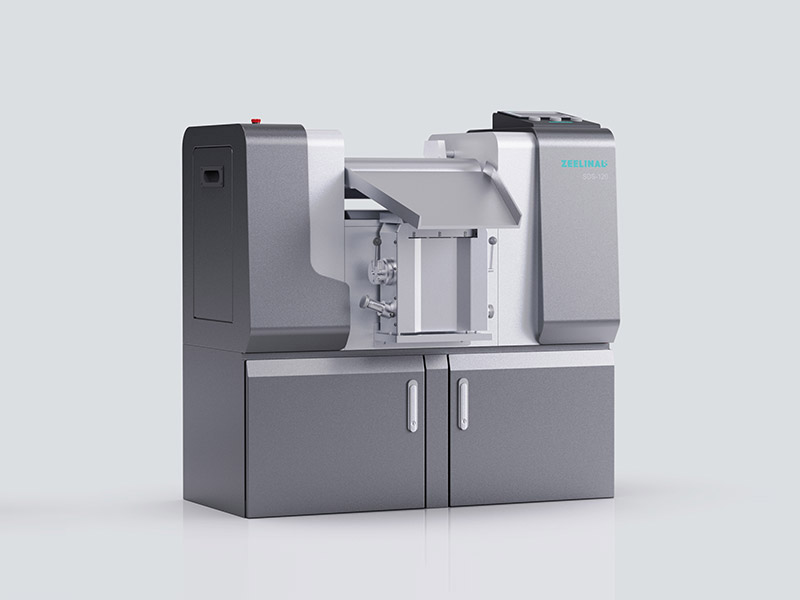
The three-roll shearing principle
Three horizontal rollers sit side by side inside the machine frame. Each roller turns in the opposite direction to its neighbor. Each roller also spins faster than the one before it. A common speed ratio is 1:2:4, so the apron roller turns four times faster than the feed roller. Some models use other ratios; the Labzee BZTRM-501, for example, runs at 400 rpm with a 1:2:4 ratio. For use cases needing finer fineness, such as electronic silver paste or photovoltaic conductive ink, a high shear 1:3:9 ratio can be used. The speed difference creates friction between the roller surfaces. That friction produces intense shear force, and the shear crushes agglomerates, which are clusters of stuck-together particles.
Material enters the first nip, the narrow gap between the feed roller and the center roller. The rollers shear the paste once there. The paste then travels to the second nip between the center roller and the apron roller, where it gets sheared again. A scraper blade lifts the finished paste off the apron roller and drops it into a collection pan. IDA Equipment describes this as a laminar shear-flow process. The mechanism differs from the impact-and-friction grinding of ball mills, and it suits high-viscosity pastes rather than free-flowing liquids or dry powders.
This shear dispersion reaches sub-micron fineness, typically in the 1–5μm range. The open-roller design exposes the paste to the air during processing. That exposure allows excellent temperature control and outgassing, which matters for heat-sensitive materials.
Gap settings and dispersion control
The gap between rollers sets how finely the mill disperses a batch. A tight gap forces the paste through a narrower opening. The shear force rises, and the output gets finer. A loose gap lets more material pass through per unit of time. Throughput rises, but fineness drops. Operators balance these two outcomes against the target particle size.
Hydraulic three roll mills from Zili use automatic pressure control to adjust roller gaps precisely. The system holds a stable shear force for grinding and dispersing high-viscosity pastes such as inks, paints, cosmetic ointments, and electronic conductive pastes. The same principle applies across the Zili range:
Three counter-rotating rollers run at different speeds to crush agglomerates and refine particles evenly.
Differential roller speeds create strong shear force that disperses pigment agglomerates and homogenizes raw materials.
The counter-rotating action disperses, grinds, and homogenizes material in a single pass through both nips.
A first pass rarely reaches the final target. Operators often run the paste through the mill several times, tightening the gap between passes. Each pass reduces the agglomerate size further. A quick gauge check between passes shows whether the batch has reached the required fineness. This step-by-step approach gives precise control over the final dispersion.
Key components
Rollers, frame, and drive system
The rollers do the actual work, so their material and hardness matter most. Standard rollers use centrifugally cast dual-metal alloy with surface hardness up to HS 70–75, according to zlhj.com. Buyers can choose other materials for specific needs.
Roller Material | Hardness / Surface Specification | Notes |
|---|---|---|
Centrifugally cast dual-metal alloy (standard) | HS 70–75 hardness | Standard rollers |
Alloy steel | Not specified | Most inexpensive option; widely used for paint, ink, and glue applications |
SiC | Not specified | Small additional cost over steel; improved wear resistance |
Zirconia ceramic | Not specified | Most expensive; chosen when zero metal contamination is required in cosmetics, pharmaceuticals, food, or electronics |
Zirconium dioxide ceramic | Surface roughness Ra ≤ 0.2 μm (ISO 12085), verified by ICP-MS on installation | For cosmetic and pharmaceutical applications requiring zero metal contamination |
Alumina ceramic | Not specified | Can be specified for metal-free processing |
The frame holds the rollers in perfect parallel alignment. A rigid mechanical architecture keeps that alignment stable under load. Full-length internal water circulation runs through each roller for dynamic cooling, which protects heat-sensitive pastes during long runs.
Feeding, cooling, and gap adjustment
Operators feed material into the slowest roller, called the feed roll. This roller pulls the paste in and spreads it evenly. zlhj.com recommends a material thickness of 3–10 mm for best results. The center roll turns at medium speed and applies shear force. The discharge roll runs fastest and handles final grinding and output.
Gap adjustment controls dispersion. The first gap, between the feed roll and center roll, applies compression. The second gap, between the center roll and apron roll, applies greater shear. Many mills hold gap precision down to 1 µm, and a smaller gap yields finer particles. Adjustment can be manual or hydraulic. Precision scrapers and customized heating units are available as accessories.
Applications and materials
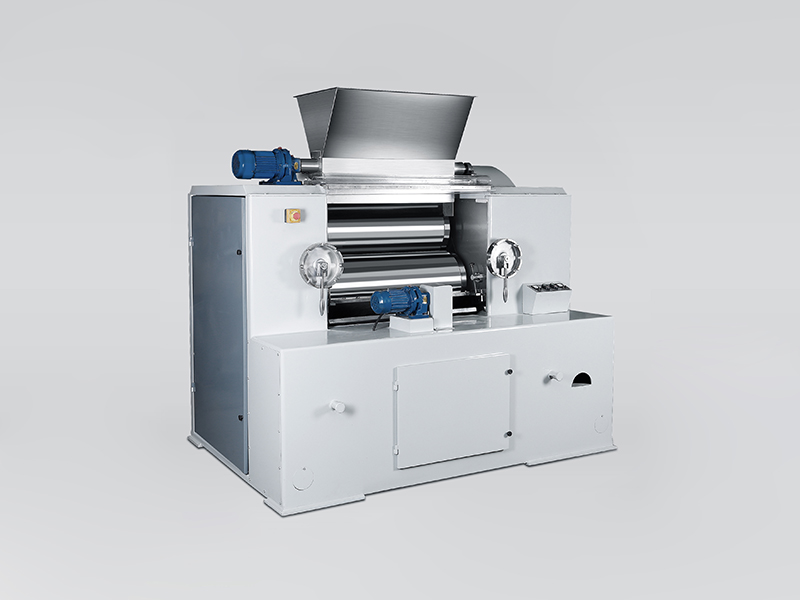
Industries that use triple roll mills
A triple roll mill serves many sectors that need tight control over particle size. Paints, inks, cosmetics, and chocolate production all rely on this machine for mixing, refining, dispersing, and homogenizing viscous materials, according to Assa Industries. Buhler Group lists wet grinding and dispersing across chemicals and cosmetics, electronic materials, and paints and coatings. KRS Dispermahltechnik adds printing ink, paint, pigments, coatings, chemicals, and advanced materials. Each industry uses the mill for a distinct job, as the table shows.
Industry | Application |
|---|---|
Printing ink | Refining paste printing inks, where the three-roll mill is the traditional finishing machine |
Paint | Grinding high-viscosity paint pastes and tinting concentrates |
Pigments | Producing pigment pastes and concentrates |
Coatings | Dispersing high-viscosity coating pastes |
Chemicals | Processing viscous chemical pastes |
Advanced materials | Refining functional pastes that need a controlled, very uniform dispersion |
The payoff differs by sector. Printing inks gain uniform pigment dispersion and consistent quality. Paints and coatings refine pigment-based formulations. Pigment production breaks down agglomerates and improves particle distribution. Specialty chemicals and industrial pastes need intensive shear on thick formulations. Food production and polymer compounding round out the list.
Regional demand shifts with local industry. North America leans on advanced cosmetics and specialty chemical research, per a LinkedIn market analysis. Germany anchors pharmaceutical quality standards in Europe. China and India drive volume demand for inks and pigments. Japan and South Korea lead in high-tech electronics, and battery materials form a growing segment.
Typical materials processed
The material list is broad. Offset and UV inks, screen print inks, and specialty adhesives pass through the rollers. Electronic pastes include silver paste for solar cells, solder paste, and battery electrode slurry. IDA Equipment reports silver paste ground below 3μm on D50 and paint pigments below 15μm on D90. Cosmetics such as lipstick, liquid foundation, sunscreen, and eye shadow de-agglomerate below 5μm. Pharmaceuticals use the mill to reduce API particle size. Soap noodles, grease, chocolate paste, and ointments also process well. Nanomaterial work includes dispersing carbon nanotubes and graphene nanoplatelets into polymers or functional coatings, in oil-based and water-based formulations. Zili mills handle viscosities up to 1,000,000 cPs.
Viscosity guides the choice. IDA Equipment places chocolate at 10,000–50,000 cPs and solder paste at 100,000–300,000 cPs. Honey at 2,000–10,000 cPs and toothpaste at 50,000–100,000 cPs also fall within range. Thick paste at 500,000–2,000,000 cPs calls for a hydraulic triple roll mill. Above 100,000 cPs, a three roll mill becomes the practical option. A quick viscosity check before purchase prevents a mismatch.
Matching the series to the job matters. Ceramic rollers in the SYS and SDS series suit contamination-sensitive electronic pastes. The SYS and S series handle heavy-duty high-end inks and continuous production. The SDS and custom series with sanitary stainless steel casings meet cosmetics and pharmaceutical standards. SD and SDS lab and pilot mills support formulation R&D and data scaling. S and SG manual mills offer cost-effective mechanical design. Buyers should weigh material chemistry, target fineness, and batch size before choosing a series.
Advantages and limitations
Where triple roll mills excel
The strongest case for this machine rests on viscosity. A triple roll mill handles materials from 10,000 to 2,000,000 mPas and processes viscosities up to 1,000,000 cPs, according to zlhj.com. Bead mills clog above 100,000 mPas, and ball mills cannot process thick pastes at all. That range explains why formulators reach for three rollers when a paste refuses to flow.
Advantage | Triple Roll Mill | Other Dispersion Methods |
|---|---|---|
Viscosity handling | Works from 10,000 to 2,000,000 mPas | Bead mills clog above 100,000 mPas; ball mills cannot process thick pastes |
Energy efficiency | Saves 15–25% energy per ton versus a hammer mill | Media mills need constant agitation energy |
Particle size control | Gap settings down to 1 micron; reaches below 5μm | — |
Maintenance | No media to replace; cleans in 5–15 minutes | Ball mills need 30–60 minutes to clean |
Temperature control | Dynamic cooling holds temperature below 50°C | — |
Precision separates this design from simpler mixers. Gap settings down to 1 micron give operators tight command over fineness and uniformity. The open-roller layout also allows outgassing and keeps heat-sensitive pastes cool. Dynamic cooling holds the material below 50°C, per zlhj.com. Rollers reach surface hardness of HS 70–75, which extends service life. Cleaning takes 5–15 minutes because no grinding media needs removal, while ball mills need 30–60 minutes. Ceramic rollers add a further benefit: they prevent metal contamination in sensitive electronic formulations.
Where they fall short
Throughput is the main trade-off. A three-roll mill processes one batch at a time through a narrow nip, so output per hour stays modest next to a media mill built for continuous flow. High-volume plants often pair it with other equipment rather than rely on it alone.
The open design cuts both ways. Exposed rollers make cleaning and inspection easy, yet they also limit the mill to pastes. Thin liquids run off the rollers instead of passing through the nips, and volatile solvents escape into the workspace. Upfront cost runs higher than a simple mechanical mixer, though zlhj.com notes that lower running costs repay the investment over time. Operators also need training, since gap and speed settings shape the final result. These limits narrow the fit; they do not weaken performance within the right application.
Triple roll mill vs. other mills
Performance and cost comparison
Each mill type fits a different job. A triple roll mill shines on thick pastes, where it delivers tight particle size control through gap settings. A bead mill suits lower-viscosity slurries and continuous flow. A ball mill handles dry powders and large batches. None of these machines wins everywhere.
Factor | Triple Roll Mill | Bead Mill | Ball Mill |
|---|---|---|---|
Best viscosity range | Thick, high-viscosity pastes | Lower-viscosity slurries | Dry or low-viscosity batches |
Particle size control | Gap settings down to 1 micron | Media-dependent | Media-dependent |
Throughput | Batch-based, modest output | Continuous, high output | High volume per batch |
Cleaning | No media to remove | Media separation needed | Media removal needed |
Upfront cost | Higher than a simple mixer | Moderate to high | Moderate |
Regulatory fit also guides the choice. Cosmetics and pharmaceutical work often calls for sanitary stainless steel casings and ceramic rollers, which Zili supplies in its SDS and custom series. Cost follows the same logic: a manual mill costs less upfront, while a hydraulic production mill repays the difference through steadier output over time.
Safety deserves a mention. Three-roller printing ink mills require emergency stop devices by standard practice. Mills operate safely when crews follow basic rules, keep hands clear of the nips, and train on gap and speed settings.
Key selection criteria
Buyers should start with the material itself. Chemistry, pigment load, and target fineness set the roller type and gap range. Viscosity comes next, since pastes above 100,000 cPs favor three-roller designs. Temperature sensitivity then decides the cooling package, and production scale sets the machine size.
Automation needs shape the final pick. Zili offers lab and pilot mills (SD/SDS series) for formulation R&D and data scaling, hydraulic production mills (SYS/SYP series) for uniform particle size reduction, and manual mills (S/SG series) for cost-effective mechanical design. Specialty accessories such as ceramic rollers, precision scrapers, and customized heating units close the remaining gaps.
A triple roll mill is a dispersion machine that passes thick, sticky materials through three rollers turning at different speeds. Its core strength lies in precise shear dispersion. Three counter-rotating rollers crush agglomerates and refine high-viscosity pastes to tight fineness.
Matching the machine to the job matters most. Buyers should weigh their material chemistry, viscosity, and production scale before choosing a model. A supplier can guide that decision and help narrow the options to the right fit.
FAQ
What viscosity range can a triple roll mill handle?
The machine processes pastes from 10,000 to 2,000,000 mPas. Zili mills handle viscosities up to 1,000,000 cPs. Thick pastes above 100,000 cPs favor this design, because bead mills clog at that level and ball mills cannot process thick pastes at all.
How many passes does a batch need?
A single pass rarely reaches the target fineness. Operators run the paste through the rollers several times and tighten the gap between passes. A gauge check between passes shows whether the batch meets the required particle size. This step-by-step method gives precise control over dispersion.
Which roller material suits a given product?
Standard rollers use centrifugally cast dual-metal alloy with hardness up to HS 70–75. Ceramic rollers in the SYS and SDS series prevent metal contamination in electronic pastes, cosmetics, and pharmaceuticals. Alloy steel costs least and suits paint, ink, and glue work.
How long does cleaning take?
Cleaning takes 5–15 minutes, because no grinding media needs removal. Ball mills need 30–60 minutes for the same job. The open-roller layout exposes the surfaces for easy inspection and wipe-down between batches.
Are these mills safe to operate?
Yes. Crews operate them safely when they follow basic rules, keep hands clear of the nips, and train on gap and speed settings. Three-roller printing ink mills require emergency stop devices by standard practice.


